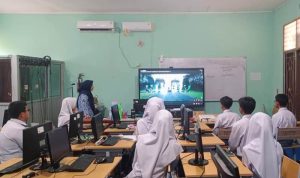




WARTA PENDIDIKAN – Imagine a classroom where digital assistants can provide immediate feedback, customize material according to students’ abilities, and even automatically translate foreign texts.
This is no longer a distant future but a reality that is starting to develop due to artificial intelligence (AI). As technology advances, AI is being used more and more in education and is considered to be able to change the way learning is done.
Then, an important question arises: should AI be integrated into classroom learning? In this essay, there are three positive impacts of using AI in classroom learning, namely, AI can enhance personalized learning, support teacher performance, and prepare students for the digital future.
The First positive impact of using AI in classroom learning education is its ability to personalize learning. AI-powered tools can track how students learn and adjust the content to suit their individual pace and needs. Studies have shown that AI systems are capable of adjusting learning materials, providing real-time feedback, and helping students focus on difficult areas (Luckin et al., 2016; Yu, 2023).
For example, platforms such as Dream Box in the United States and Squirrel AI in China use this method to customize learning materials according to students’ individual needs. This allows each student to learn at their own pace, so they don’t feel left behind or forced to quickly grasp the material.

In addition, the learning atmosphere becomes more comfortable as students get support that matches their learning rhythm. However, researchers like Kasneci et al. (2023) warn that overreliance on AI tools may hinder students’ creative and independent thinking.
When students constantly rely on AI to complete their assignments, their ability to express ideas on their own may be diminished. In some observations, students were able to answer questions using AI tools like Chat GPT, but struggled to explain the same ideas independently.
The second positive impact of using AI in classroom learning education is its ability to assist teachers—not replace them. AI can take over time-consuming administrative tasks, such as grading quizzes or recording student attendance, so that teachers have more time to interact directly with their students.
According to Merentek et al. (2023), AI can support teachers in guiding students more effectively and creatively. In addition, AI also provides quick information on students’ learning progress, allowing teachers to follow up immediately if a student falls behind.
However, in underfunded schools, AI may be used to reduce costs, resulting in fewer teachers. Some cases have shown that AI was used as justification to reduce teaching staff, which led to decreased human interaction in learning environments (Chassignol et al., 2018).
Moreover, concerns have been raised about overdependence on AI tools that may contribute to plagiarism and weaken students’ critical thinking skills (Dempere et al., 2023; Cotton et al., 2024). When that happens, the quality of teaching may suffer, especially in schools where students need personal guidance the most.
The last positive impact of using AI in classroom learning education is helping teachers and students. AI plays a key role in fostering digital skills, creativity, and ethical thinking (OECD, 2021; Fatmawati et al., 2024). The use of AI in the classroom gives students an early exposure to the technologies they will use in the future.
For example, Finland has incorporated AI education into its high school curriculum to help students understand algorithms and be better prepared for the digital world. However, not all schools have the same opportunity. According to a UNESCO report (2020), only about 40% of schools in low-income countries have stable internet access, and the number of schools with advanced technology devices is much less.
If there is not enough support for infrastructure and teacher training, the application of AI in education could widen the digital divide and leave students from disadvantaged groups behind.
In conclusion, integrating artificial intelligence into classroom learning has real potential to improve education—by personalizing instruction, supporting teachers, and preparing students for the future. Although the benefits are clear, concerns remain regarding overdependence on technology, the risk of plagiarism, and weakening of critical thinking skills.
The key issue is not whether we should use AI, but rather how we should use it. Therefore, any attempt to incorporate AI into the classroom should be done carefully, upholding fairness and openness and still prioritizing the human aspect of education.
Writer: Alifia Maharani and Elfi